Tuesday, October 18, 2011
CPYU Book Reviews
For current CPYU book reviews please see CPYU's ENGAGE E-Journal and Simply Youth Newsletters.

Monday, June 20, 2011
Consuming Youth
 In recent years, the news media have reported on a handful of child kidnapping stories that for years remained unresolved. While each of these stories are complex and nuanced, it’s always surprising to learn that the unwilling captive was somehow brainwashed to the point of assimilating themselves into the system of the captor to the point where they lived there willingly, rather than trying to escape. I wonder if the same dynamic isn’t at work on us and our kids as marketing hijacks our hearts and minds so effectively, that we willingly enjoy and seek out the opportunity to keep riding along?
In their book, Consuming Youth: Leading Teens Through Consumer Culture (Zondervan, 2010), John Berard, James Penner and Rick Bartlett take readers on a tour of the history of consumer culture and how it established consumption as the primary purpose of our kids. Youth culture and modern adolescence are relatively recent social and economic inventions. They have functioned to shape our identities so effectively that we’ve just come to accept that this is the way it is, and the way it’s supposed to be. But the trio of authors asks those of us who love and care for kids to step back and see that consumer culture is really doing to our kids. Then, they start a conversation about what it means to re-think youth ministry in ways that shape significantly different ideology of youth, one that debunks the myths of consumer culture while helping them find their identity and calling in Christ.
Consuming Youth is a thoughtful book that raises important issues and can get us started on the journey to reframing our ministries in response to the ways that marketing and consumer culture so quickly and easily rope our kids – and us – in. This is one worth reading and discussing in a group.
--Walt Mueller
Thursday, June 9, 2011
Teenology
 The teenage years can seem like a minefield at times: you want to give your children the freedom to strongly walk forth and become responsible adults, and yet you want to protect them from making choices that could rupture not only their present circumstances but their futures as well. Plus, given the rugged terrain that teens have to navigate—pornography available online and via cellphones, the extreme pressure on body image by the culture, the epidemic of cyberbullying, just to name a few—anyone given the task of raising teenagers is in great need of guidance.
Jim Burns, a man who has devoted his life to helping kids and who is the father of three himself, responds to this need for guidance in his book, Teenology: The Art of Raising Great Teenagers (Bethany House, 2010). In his book, Burns tackles some of the major issues surrounding the task of raising teenagers into responsible adults. He gives a basic overview of the process of changes known as adolescence and then delves into the problems that can occur, whether it’s a block in communication between parents and teens, or combating the allure of pornography or sexual promiscuity that is so prominent in today’s culture. And though Burns delves into uncomfortable topics, he comes from the standpoint of one who has already been through this process three times before with his own children, and countless other times with his youth groups. His main message is to “Stay calm. Adolescence is a temporary transition. Work your plan. Hold on to your seat belt. Get as emotionally, physically, and spiritually healthy as you possibly can, and before you know it, that sweet kid who morphed into a teen and sometimes hates you will become a responsible adult.”
There is no book (to my knowledge) that provides easy answers for raising God-serving teenagers. But, if you are looking for a foundation from which to understand the “art,” as Burns calls it, Teenology is a good place to start. A book more focused on practical solutions than theoretical wonderings, this is a good resource for parents or soon-to-be parents desiring advice as well as tools to best help their children maneuver the “minefield” of adolescence.
--Angelina Deola
Wednesday, June 1, 2011
Too Small To Ignore: Why the Least of These Matters Most
 It’s no secret that Jesus had a big heart for little children. He calls us to love, lead, and care for the smallest among us as well. Ironically, we live in a time where parents are almost over-committed to their children, but children are suffering from both neglect and over-stimulation. We struggle to get it right.
Wess Stafford has been loving and ministering to children for decades. He serves as the President of Compassion International, a Christian childcare ministry that serves impoverished children globally through church-based programs funded by child sponsors. Currently, over 1 million children are sponsored through Compassion International. Stafford has a heart for the world’s young not just because that’s what he’s been called to, but because as child himself he was victimized by the very people he should have been able to trust. The son of missionaries to Africa, Stafford spent several months a year at a Christian boarding school. It was there that he suffered years of physical and sexual abuse at the hands of the school’s teachers and administrators. He tells that story and issues a call to care for the young in his book, Too Small To Ignore: Why the Least of These Matters Most (WaterBrook, 2007). By taking readers through the Scriptures and the realities of our current culture, Stafford calls readers to make children a priority in every area of life. He invites readers to become champions for children, offering practical suggestions on how to make that happen.
While this is not a book on parenting or youth ministry, it is a book that parents and youth workers will benefit from reading. After all, our ministries and families must be centered on living out Biblical priorities in the way we raise and relate to the kids we know and love. Too Small To Ignore is worth your time and attention. As an added bonus, the book includes study and discussion questions that lends it well to individual reflection or small group discussion.
--Walt Mueller
Thursday, May 26, 2011
The Wisdom of Stability
 So much of our lives consist of running--running from one event to another, running through high school, college, and job training, running to get the telephone or running to the store to buy the newest version of the iPhone. In our fast-paced American culture, speed and mobility are paramount.
Yet in his book, The Wisdom of Stability: Rooting Faith in a Mobile Culture (Paraclete Press, 2010), Jonathan Wilson-Hartgrove explores the costs of running and the often overlooked advantages of staying still. Wilson-Hartgrove looks to the wisdom of the desert fathers and mothers—the likes of St. Antony, Julian of Norwich, and Bernard of Clairvaux—as well as to the lessons learned from more current voices like Wendell Berry. Wilson-Hartgrove’s own restless past and rooted present stand behind his assertion that the difficult discipline of stability is worth “staying” with.
Wilson-Hartgrove believes that stability is life-giving in our draining mobile culture. Learning the discipline means learning to follow the Greatest Commandment to its fullest, to live in long-term community where you and the other are known fully and loved deeply. Using examples of communities from the civil rights movement, Wilson-Hartgrove shows how the body of Christ unites when its members breathe the same air and encounter the same battles together. When that unified community gathers on a Sunday, after weathering the storms that come from living life together during the week, they are able to sing in unison against the devil’s schemes and in eager expectancy of God’s greater plans.
What makes Stability an especially worthy read is that even if your life is, at least for the moment, inescapably unstable (i.e. child running between divorced parents, young adult on the brink of graduation, adult in the process of changing or finding jobs, etc.), Wilson-Hartgrove addresses more than the task of staying in one place. In his chapter entitled, “Midday Demons,” he focuses on stability as a daily discipline in one’s prayer life. Wilson-Hartgrove recognizes, along with a long line of Christians before him, that it is often after we commit to stay still--in prayer, solitude, or study--that we are tempted with the expected yet overbearing “midday demons:” demons of boredom and ambition. Speaking with the voices of the desert fathers and mothers, Wilson-Hartgrove gives practical, wise, and surprisingly simple methods to fight against what tears us away from solitude with God.
The Wisdom of Stability is a must-read for youth leaders, parents, and teenagers alike. The idea of “being rooted” is counter-cultural in our day for adults and students, yet rootedness yields fruits of patience, compassion, and a better understanding of ourselves and God. Wilson-Hartgrove lovingly challenges us to learn to love God and our neighbors more deeply by slowing down. With stability, we have the chance to not only enter the world of the other, but to loyally join the other in genuine community.
--Angelina Deola
Monday, May 23, 2011
The Pastor: A Memoir by Eugene Peterson
 Eugene Peterson is probably best known for his Bible translation The Message, or his countless books on the spiritual life or his many years as a seminary professor at Regent College. What probably isn’t as well known, is that Peterson was a pastor for 29 years before publishing his contemporary version of scripture, or writing many of his books or teaching at a seminary! Now retired and living in his hometown in Montana, Peterson’s latest book reflects on his life as a pastor. The Pastor: A Memoir (HarperOne, 2011) offers readers a behind-the-scenes look at Peterson’s life as a pastor of a Presbyterian church-plant outside of Baltimore, Maryland. The book explains how he reluctantly and haphazardly became a pastor, growing into his call overtime.
Writing honestly about his own struggles as a pastor, he is especially concerned with the state of the pastoral vocation today: “I didn’t want to be a religious professional whose identity was institutionalized. I didn’t want to be a pastor who sense of worth derived from whether people affirmed or ignored me. In short, I didn’t want to be a pastor in the ways that were most in evidence and more rewarded in the American consumerist and celebrity culture.” Instead, Peterson became a pastor with a ministry that was rooted in scripture and prayer; one that focused on worship of God and care for people over programs and number of attendees; and offered his Baltimore suburb something that was different from the world, not accommodating to culture.
Shepherding a flock of sinners is never easy, to be sure. But it’s definitely not easy being a pastor in today’s world. So much cultural pressure is working against people from becoming the pastors that are so desperately needed. Peterson’s book reminds pastors to keep first things first and reminds congregants of the challenges facing pastors today. This book is highly recommended for all people who care about the church and care about the people God has called to lead them.
--Derek Melleby
Thursday, May 12, 2011
Kick Me: Adventures in Adolescence
 I read lots of books on theology, culture, and teenagers. Every now and then I just get flat-out tired of reading stuff that forces me to go deep. Ever feel that way? I was feeling that way when I wandered into the airport bookstore before a long, cross-country flight. Then, I spotted it! It was the cover and the title that caught my attention. The cover featured a family picture from the 1970s complete with geeky kid, under the words Kick Me: Adventures in Adolescence (Three Rivers Press, 2002). Written by the creator of the TV series Freaks and Geeks, Paul Feig, this book takes readers on a hilarious autobiographical journey through junior high and high school.
Because Feig grew up during the 70s, some of the cultural references are unique to the times. Those of us males who grew up about the same time might think Feig is writing about us, as if he had gotten into our heads and recorded what we were thinking, experiencing, and feeling as our hormones were setting themselves in motion and bouncing around out-of-control. But Feig captures the life-stage in ways that not only make this book a laugh-out-loud (which I did several times on the flight!) read for anyone, but a helpful reminder of just how difficult and confusing the teen years can be for adolescents of all generations.
While the book is really funny, it does serve as a reminder of just how important it is for our kids to receive nurture and support from home and church. We know that adolescence in today’s world is no laughing matter for far too many kids. From Feig’s recounting of everything from dodgeball to dating. . . this is one hilarious book!
Monday, May 9, 2011
Monday, May 2, 2011
Somewhere More Holy
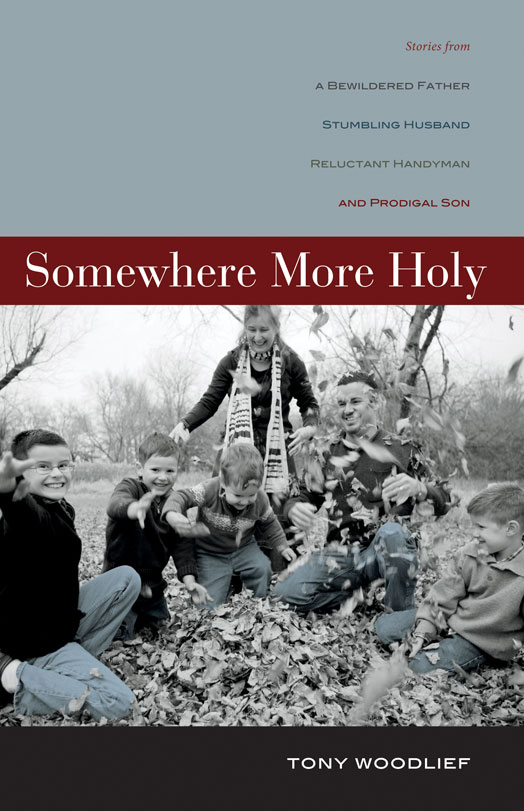 Most of us don’t spend much time thinking about the different rooms of our homes, reflecting back on memories, and how God was and is present in each room. Thankfully for readers, author Tony Woodlief took the time to do so and invites us into his home in Somewhere More Holy: Stories from a Bewildered Father, Stumbling Husband, Reluctant Handyman, and Prodigal Son (Zondervan, 2010). Through each chapter, Woodlief focuses on a different room in his home, and shares with us the ups and downs he and his family have experienced in each one. Much of his story revolves around the death of his 3 year old daughter to cancer and how it has greatly impacted him and played a role in his faith. His personal struggles with guilt, doubt, anger with God, a broken past, sinful behavior, and a marriage slowly falling apart are all revealed in heart-wrenching but honest ways.
Though Woodlief wanted to give up on God, his family, and even himself, the pages of his book reveal that God’s grace was at work in the midst of all the pain and brokenness even if he was completely blind to it at the time. His pain and struggles are not gone, and his attempts at figuring out how to live out these realities in front of his wife and 4 boys, all born after their sister passed away, makes this book that more approachable, especially to parents living with young children. Laughter and humor also ring true as he tells tales of his boys, including the water-strewn disasters (and bodily functions) that take place in the bathroom, their turning of the living room into a wrestling ring, and the joy that takes place when they all gather together on their parents’ bed, despite the sleep (and other activities) of their parents that are often interrupted.
These reflections, as he walks us from room to room, are a way for Woodlief to wrestle with issues related to raising his children in a way that points them to Christ and brings glory to God and about being a loving and faithful husband. More than that, he helps us all understand that we might not understand God, or fully grasp His love and grace and we may even feel like we don’t deserve it, yet there it is for the taking. Accepting this, as Woodlief has, will help us realize we can make our homes somewhere more holy, as the title suggests.
Tuesday, April 26, 2011
One.Life Giveaway Winners!
Drumroll please…
The three winners (randomly selected) for the One.Life giveaway are:
Please send us an email (cpyu@cpyu.org) with your mailing address to claim your prize! (Include this subject line: One.Life Giveaway)
We still have more copies of One.Life to giveaway… stay tuned on Facebook (CPYU “Group”) and Twitter for more chances to win!
Thanks for playing!
The three winners (randomly selected) for the One.Life giveaway are:
Darryl Schafer
Doug
Rob
Please send us an email (cpyu@cpyu.org) with your mailing address to claim your prize! (Include this subject line: One.Life Giveaway)
We still have more copies of One.Life to giveaway… stay tuned on Facebook (CPYU “Group”) and Twitter for more chances to win!
Thanks for playing!
Subscribe to:
Posts (Atom)

 Posts
Posts