Thursday, May 26, 2011

The Wisdom of Stability

So much of our lives consist of running--running from one event to another, running through high school, college, and job training, running to get the telephone or running to the store to buy the newest version of the iPhone. In our fast-paced American culture, speed and mobility are paramount.

Yet in his book, The Wisdom of Stability: Rooting Faith in a Mobile Culture (Paraclete Press, 2010), Jonathan Wilson-Hartgrove explores the costs of running and the often overlooked advantages of staying still. Wilson-Hartgrove looks to the wisdom of the desert fathers and mothers—the likes of St. Antony, Julian of Norwich, and Bernard of Clairvaux—as well as to the lessons learned from more current voices like Wendell Berry. Wilson-Hartgrove’s own restless past and rooted present stand behind his assertion that the difficult discipline of stability is worth “staying” with.

Wilson-Hartgrove believes that stability is life-giving in our draining mobile culture. Learning the discipline means learning to follow the Greatest Commandment to its fullest, to live in long-term community where you and the other are known fully and loved deeply. Using examples of communities from the civil rights movement, Wilson-Hartgrove shows how the body of Christ unites when its members breathe the same air and encounter the same battles together. When that unified community gathers on a Sunday, after weathering the storms that come from living life together during the week, they are able to sing in unison against the devil’s schemes and in eager expectancy of God’s greater plans.

What makes Stability an especially worthy read is that even if your life is, at least for the moment, inescapably unstable (i.e. child running between divorced parents, young adult on the brink of graduation, adult in the process of changing or finding jobs, etc.), Wilson-Hartgrove addresses more than the task of staying in one place. In his chapter entitled, “Midday Demons,” he focuses on stability as a daily discipline in one’s prayer life. Wilson-Hartgrove recognizes, along with a long line of Christians before him, that it is often after we commit to stay still--in prayer, solitude, or study--that we are tempted with the expected yet overbearing “midday demons:” demons of boredom and ambition. Speaking with the voices of the desert fathers and mothers, Wilson-Hartgrove gives practical, wise, and surprisingly simple methods to fight against what tears us away from solitude with God.

The Wisdom of Stability is a must-read for youth leaders, parents, and teenagers alike. The idea of “being rooted” is counter-cultural in our day for adults and students, yet rootedness yields fruits of patience, compassion, and a better understanding of ourselves and God. Wilson-Hartgrove lovingly challenges us to learn to love God and our neighbors more deeply by slowing down. With stability, we have the chance to not only enter the world of the other, but to loyally join the other in genuine community.

--Angelina Deola

Monday, May 23, 2011

The Pastor: A Memoir by Eugene Peterson

Eugene Peterson is probably best known for his Bible translation The Message, or his countless books on the spiritual life or his many years as a seminary professor at Regent College. What probably isn’t as well known, is that Peterson was a pastor for 29 years before publishing his contemporary version of scripture, or writing many of his books or teaching at a seminary! Now retired and living in his hometown in Montana, Peterson’s latest book reflects on his life as a pastor. The Pastor: A Memoir (HarperOne, 2011) offers readers a behind-the-scenes look at Peterson’s life as a pastor of a Presbyterian church-plant outside of Baltimore, Maryland. The book explains how he reluctantly and haphazardly became a pastor, growing into his call overtime.

Writing honestly about his own struggles as a pastor, he is especially concerned with the state of the pastoral vocation today: “I didn’t want to be a religious professional whose identity was institutionalized. I didn’t want to be a pastor who sense of worth derived from whether people affirmed or ignored me. In short, I didn’t want to be a pastor in the ways that were most in evidence and more rewarded in the American consumerist and celebrity culture.” Instead, Peterson became a pastor with a ministry that was rooted in scripture and prayer; one that focused on worship of God and care for people over programs and number of attendees; and offered his Baltimore suburb something that was different from the world, not accommodating to culture.

Shepherding a flock of sinners is never easy, to be sure. But it’s definitely not easy being a pastor in today’s world. So much cultural pressure is working against people from becoming the pastors that are so desperately needed. Peterson’s book reminds pastors to keep first things first and reminds congregants of the challenges facing pastors today. This book is highly recommended for all people who care about the church and care about the people God has called to lead them.

--Derek Melleby

Thursday, May 12, 2011

Kick Me: Adventures in Adolescence

I read lots of books on theology, culture, and teenagers. Every now and then I just get flat-out tired of reading stuff that forces me to go deep. Ever feel that way? I was feeling that way when I wandered into the airport bookstore before a long, cross-country flight. Then, I spotted it! It was the cover and the title that caught my attention. The cover featured a family picture from the 1970s complete with geeky kid, under the words Kick Me: Adventures in Adolescence (Three Rivers Press, 2002). Written by the creator of the TV series Freaks and Geeks, Paul Feig, this book takes readers on a hilarious autobiographical journey through junior high and high school.

Because Feig grew up during the 70s, some of the cultural references are unique to the times. Those of us males who grew up about the same time might think Feig is writing about us, as if he had gotten into our heads and recorded what we were thinking, experiencing, and feeling as our hormones were setting themselves in motion and bouncing around out-of-control. But Feig captures the life-stage in ways that not only make this book a laugh-out-loud (which I did several times on the flight!) read for anyone, but a helpful reminder of just how difficult and confusing the teen years can be for adolescents of all generations.

While the book is really funny, it does serve as a reminder of just how important it is for our kids to receive nurture and support from home and church. We know that adolescence in today’s world is no laughing matter for far too many kids. From Feig’s recounting of everything from dodgeball to dating. . . this is one hilarious book!

Monday, May 2, 2011

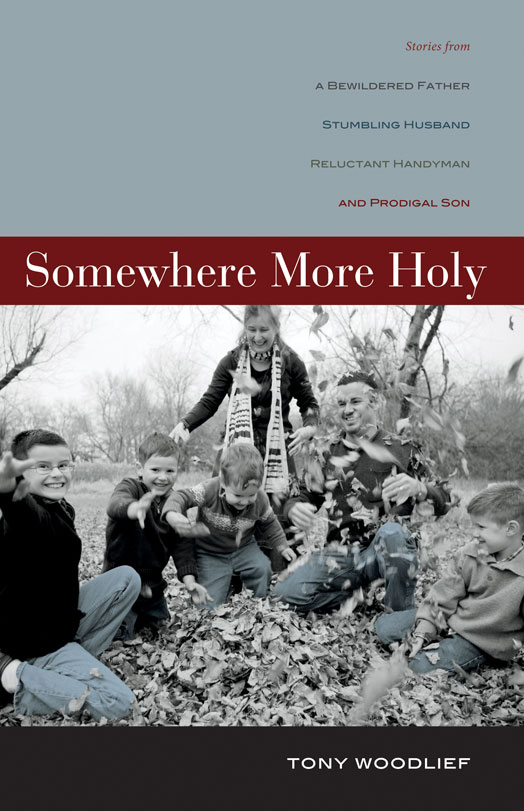
Somewhere More Holy

Most of us don’t spend much time thinking about the different rooms of our homes, reflecting back on memories, and how God was and is present in each room. Thankfully for readers, author Tony Woodlief took the time to do so and invites us into his home in Somewhere More Holy: Stories from a Bewildered Father, Stumbling Husband, Reluctant Handyman, and Prodigal Son (Zondervan, 2010). Through each chapter, Woodlief focuses on a different room in his home, and shares with us the ups and downs he and his family have experienced in each one. Much of his story revolves around the death of his 3 year old daughter to cancer and how it has greatly impacted him and played a role in his faith. His personal struggles with guilt, doubt, anger with God, a broken past, sinful behavior, and a marriage slowly falling apart are all revealed in heart-wrenching but honest ways.

Though Woodlief wanted to give up on God, his family, and even himself, the pages of his book reveal that God’s grace was at work in the midst of all the pain and brokenness even if he was completely blind to it at the time. His pain and struggles are not gone, and his attempts at figuring out how to live out these realities in front of his wife and 4 boys, all born after their sister passed away, makes this book that more approachable, especially to parents living with young children. Laughter and humor also ring true as he tells tales of his boys, including the water-strewn disasters (and bodily functions) that take place in the bathroom, their turning of the living room into a wrestling ring, and the joy that takes place when they all gather together on their parents’ bed, despite the sleep (and other activities) of their parents that are often interrupted.

These reflections, as he walks us from room to room, are a way for Woodlief to wrestle with issues related to raising his children in a way that points them to Christ and brings glory to God and about being a loving and faithful husband. More than that, he helps us all understand that we might not understand God, or fully grasp His love and grace and we may even feel like we don’t deserve it, yet there it is for the taking. Accepting this, as Woodlief has, will help us realize we can make our homes somewhere more holy, as the title suggests.

Tuesday, April 26, 2011

One.Life Giveaway Winners!

Drumroll please…

The three winners (randomly selected) for the One.Life giveaway are:

Darryl Schafer
Doug
Rob

Please send us an email (cpyu@cpyu.org) with your mailing address to claim your prize! (Include this subject line: One.Life Giveaway)

We still have more copies of One.Life to giveaway… stay tuned on Facebook (CPYU “Group”) and Twitter for more chances to win!

Thanks for playing!

Monday, April 18, 2011

Scot McKnight's One.Life Giveaway!

It’s time to give away some FREE books! This week on CPYU Bookshelf we’re giving away 3 copies of One.Life: Jesus Calls, We Follow by Scot McKnight!

McKnight was motivated to write One.Life by wrestling with one central question: What is a Christian? In a very creative and engaging manner, McKnight is providing an overview of the Christian faith. Here’s a question for our readers, for a chance to win a FREE book:

What other books do you think provide a helpful overview of the Christian faith?


On Monday (April 25) we will randomly select three winners from the comments. Only one comment (entry) per person, please.

Be sure to check out Facebook and Twitter for more ways to win FREE copies of One.Life.

Wednesday, April 13, 2011

One.Life: Jesus Calls, We Follow

It is becoming increasingly more obvious that we are living in a “post-Christian” society. Meaning, more and more people no longer have Christian reference points for a Christian understanding of the world. Put another way, it’s not so much that people are antagonistic toward the Christian faith, it’s that most people have no idea what the basic Christian beliefs are. This provides a remarkable opportunity for the church to introduce people to the faith without having to undo some of the Christian “baggage” which was associated with the cultural Christianity of years gone by.

This is what’s great about Scot McKnight’s new book One.Life: Jesus Calls, We Follow (Zondervan, 2010): McKnight is able to connect with both audiences. The book is good for people that have grown up in the church as well as people who are learning about the faith for the first time. Here’s McKnight’s main point: the church needs to have a more biblical understanding of what it means to be a follower of Christ. In the introduction, McKnight tells his own story about wrestling with the deeper meaning of being a disciple. For many years of his life, when asked what a Christian is, he would respond: “A Christian is someone who has accepted Jesus; and the Christian life is the development of personal (private) practices of piety, separation from sin and the world, and a life dedicated to rescuing sinners from hell.” Basically, McKnight was raised to understand Christianity as being “saved” from hell and being a morally good person, demonstrated by reading the bible, going to church and trying to get other people to do the same. There is some truth to this description, to be sure, but McKnight is convinced that it isn’t complete. He now answers the question much more simply: “A Christian is someone who follows Jesus.”

The rest of the book explains what “following Jesus” looks like in everyday practice. Chapters cover a wide-range of subjects, including: Kingdom, Love, Peace, Wisdom, Church, Sex, Vocation and Eternity. Many of McKnight’s examples are stories of college students who are eager to follow Jesus but aren’t sure how, making it a great book for youth and college pastors, parents of teenagers and younger Christians. McKnight does a masterful job of taking complex biblical concepts and making accessible to a wide-range of people, regardless of where they are on their spiritual journey.


Click here to visit Jesus Creed (Scot McKnight's blog)


Big News: Thanks to the good people at Zondervan, next week we will be giving away copies of One.Life! Be sure to check out Facebook, Twitter and our e-Update for details.

Tuesday, March 29, 2011

New Book from Walt Mueller!

99 Thoughts for Parents of Teenagers: The Truth on Raising Teensagers From Parents Who Have Been There


If you’re the parent of a teenager, you need all the help you can get. How do you help your children make wise choices? How do you give your teenagers freedom to make their own choices while still providing a guiding hand? How do you invest your time and energy in ways that make an eternal difference in your children’s lives?

Walt Mueller delivers the goods in 99 Thoughts for Parents of Teenagers, a no-holds-barred look at the good, bad, and ugly aspects of parenting teenagers. Drawing on his experience as a parent of four children who have passed through their teenage years, Walt shares wisdom, thoughts, insights, and suggestions for making the teenage years count. If you’re a parent, you’ll want to read, devour, and absorb the dynamic truths in this book. And if you’re a youth worker, you’ll want to get this book into the hands of parents in your ministry to guide them, encourage them, and give them insights on fulfilling God’s great call to raise children who pursue a Jesus-centered life.


Tuesday, March 8, 2011

Pure Scum: The Left-Out, the Right-Brained and the Grace of God

It seems that Mike Sares never wanted to pastor a church with such a brazen name. But more importantly, he was open to following God’s call. In Pure Scum: The Left-Out, the Right-Brained and the Grace of God (InterVarsity Press, 2010) pastor Mike Sares shares with us his experiences leading up to, and being the pastor of Scum of the Earth Church in Denver, Colorado. The church’s name comes from 1 Corinthians 4:13. Scum of the Earth is a church for those who wouldn’t normally set foot in a typical suburban evangelical congregation for fear of rejection. Goths, punks, drunkards and homeless are regular attendees at Scum.

In Pure Scum we are taken on a journey that explores what it means to follow Christ, to listen to his calling, and to be obedient to it, even when doing so means taking substantial risks. Sares shows us that following Christ is an adventure, and he firmly holds to the idea that it is an adventure worth taking. To pastor a church like Scum is to experience extreme hardship, to share in immense pain and to live in community with many of whom the world has rejected. The characters encountered in this book are loveable because Sares shows us that they too, matter to God.

At its heart, Pure Scum reminds readers that we are all in fact, broken; we are all desperately in need of a savior. This book points us to a God whose grace is far greater than we realize, far greater than we’ll ever know or understand this side of heaven. Hopefully reading this book will stretch readers to more fully understand that God’s love reaches out to those whom we often overlook, even despise at times. We are all messed up, and perhaps it’s because the “left-out” and the “right-brained” realize this more about themselves than others that they experience God’s grace in ways that are so compelling.
Reviewed by Chris Wagner