It’s time to give away some FREE books! This week on CPYU Bookshelf we’re giving away 3 copies of One.Life: Jesus Calls, We Follow by Scot McKnight!
McKnight was motivated to write One.Life by wrestling with one central question: What is a Christian? In a very creative and engaging manner, McKnight is providing an overview of the Christian faith. Here’s a question for our readers, for a chance to win a FREE book:
What other books do you think provide a helpful overview of the Christian faith?
On Monday (April 25) we will randomly select three winners from the comments. Only one comment (entry) per person, please.
Be sure to check out Facebook and Twitter for more ways to win FREE copies of One.Life.
Monday, April 18, 2011

Wednesday, April 13, 2011
One.Life: Jesus Calls, We Follow
 It is becoming increasingly more obvious that we are living in a “post-Christian” society. Meaning, more and more people no longer have Christian reference points for a Christian understanding of the world. Put another way, it’s not so much that people are antagonistic toward the Christian faith, it’s that most people have no idea what the basic Christian beliefs are. This provides a remarkable opportunity for the church to introduce people to the faith without having to undo some of the Christian “baggage” which was associated with the cultural Christianity of years gone by.
This is what’s great about Scot McKnight’s new book One.Life: Jesus Calls, We Follow (Zondervan, 2010): McKnight is able to connect with both audiences. The book is good for people that have grown up in the church as well as people who are learning about the faith for the first time. Here’s McKnight’s main point: the church needs to have a more biblical understanding of what it means to be a follower of Christ. In the introduction, McKnight tells his own story about wrestling with the deeper meaning of being a disciple. For many years of his life, when asked what a Christian is, he would respond: “A Christian is someone who has accepted Jesus; and the Christian life is the development of personal (private) practices of piety, separation from sin and the world, and a life dedicated to rescuing sinners from hell.” Basically, McKnight was raised to understand Christianity as being “saved” from hell and being a morally good person, demonstrated by reading the bible, going to church and trying to get other people to do the same. There is some truth to this description, to be sure, but McKnight is convinced that it isn’t complete. He now answers the question much more simply: “A Christian is someone who follows Jesus.”
The rest of the book explains what “following Jesus” looks like in everyday practice. Chapters cover a wide-range of subjects, including: Kingdom, Love, Peace, Wisdom, Church, Sex, Vocation and Eternity. Many of McKnight’s examples are stories of college students who are eager to follow Jesus but aren’t sure how, making it a great book for youth and college pastors, parents of teenagers and younger Christians. McKnight does a masterful job of taking complex biblical concepts and making accessible to a wide-range of people, regardless of where they are on their spiritual journey.
Click here to visit Jesus Creed (Scot McKnight's blog)
Big News: Thanks to the good people at Zondervan, next week we will be giving away copies of One.Life! Be sure to check out Facebook, Twitter and our e-Update for details.
Tuesday, March 29, 2011
New Book from Walt Mueller!
 99 Thoughts for Parents of Teenagers: The Truth on Raising Teensagers From Parents Who Have Been There
 If you’re the parent of a teenager, you need all the help you can get. How do you help your children make wise choices? How do you give your teenagers freedom to make their own choices while still providing a guiding hand? How do you invest your time and energy in ways that make an eternal difference in your children’s lives?
Walt Mueller delivers the goods in 99 Thoughts for Parents of Teenagers, a no-holds-barred look at the good, bad, and ugly aspects of parenting teenagers. Drawing on his experience as a parent of four children who have passed through their teenage years, Walt shares wisdom, thoughts, insights, and suggestions for making the teenage years count. If you’re a parent, you’ll want to read, devour, and absorb the dynamic truths in this book. And if you’re a youth worker, you’ll want to get this book into the hands of parents in your ministry to guide them, encourage them, and give them insights on fulfilling God’s great call to raise children who pursue a Jesus-centered life.
Tuesday, March 8, 2011
Pure Scum: The Left-Out, the Right-Brained and the Grace of God
 It seems that Mike Sares never wanted to pastor a church with such a brazen name. But more importantly, he was open to following God’s call. In Pure Scum: The Left-Out, the Right-Brained and the Grace of God (InterVarsity Press, 2010) pastor Mike Sares shares with us his experiences leading up to, and being the pastor of Scum of the Earth Church in Denver, Colorado. The church’s name comes from 1 Corinthians 4:13. Scum of the Earth is a church for those who wouldn’t normally set foot in a typical suburban evangelical congregation for fear of rejection. Goths, punks, drunkards and homeless are regular attendees at Scum.
In Pure Scum we are taken on a journey that explores what it means to follow Christ, to listen to his calling, and to be obedient to it, even when doing so means taking substantial risks. Sares shows us that following Christ is an adventure, and he firmly holds to the idea that it is an adventure worth taking. To pastor a church like Scum is to experience extreme hardship, to share in immense pain and to live in community with many of whom the world has rejected. The characters encountered in this book are loveable because Sares shows us that they too, matter to God.
At its heart, Pure Scum reminds readers that we are all in fact, broken; we are all desperately in need of a savior. This book points us to a God whose grace is far greater than we realize, far greater than we’ll ever know or understand this side of heaven. Hopefully reading this book will stretch readers to more fully understand that God’s love reaches out to those whom we often overlook, even despise at times. We are all messed up, and perhaps it’s because the “left-out” and the “right-brained” realize this more about themselves than others that they experience God’s grace in ways that are so compelling.
Reviewed by Chris Wagner
Monday, January 31, 2011
Good News for Anxious Christians: An Interview with Author Philip Cary
 An interview with author Philip Cary by Angelina Deola.
Dr. Philip Cary, professor of Philosophy at Eastern University, has released several books, the most recent entitled: Good News for Anxious Christians: 10 Practical Things You Don’t Have to Worry About (Brazos Press). Though Dr. Cary is unapologetically attacking the unbiblical tenets of what he calls the “new evangelical theology,” he does so with the intention of preaching the gospel—that is, the good news of Jesus Christ. He has a deep love for the gospel and for God’s people, and it is his belief that ideas like “hearing God in your heart,” “finding God’s will for your life,” or “having to continually experience joy” are hurting Christians rather than helping them.
Good News for Anxious Christians offers a much needed look at what the gospel is and how Christians can live in light of the gospel, not adhering to extra-biblical ideas but instead clinging to the mystery and miracle that is found in the Son of God himself.
CPYU: You said in the introduction to Good News for Anxious Christians that your inspiration for writing the book came mostly from interacting with your students because they “are most oppressed by the new evangelical theology and most in need of permission not to believe it.” What was your experience like interacting with these students over the years, and why do you think that it’s important to preach the gospel by revealing the mis-teachings of the new evangelical theology?
Cary: Well, I think that what I call the new evangelical theology—not a very inspired label but nonetheless a useful one—makes people awfully anxious. So for instance, a whole lot of students come from my university thinking they’re supposed to find God’s will for their lives and they get worried that they might not find God’s will for their lives, or they might find God’s second best will for their lives, or they might not find the one person that God has planned for them to marry. And, I think these worries do them a lot of harm and make it difficult for them to make responsible adult decisions.
What an adult decision maker needs to do, like Solomon when he prays for wisdom, is discern between good and bad decisions--not to discern “God’s will for your life.” Solomon asks for a heart that discerns good from bad, because that’s what responsible adults are good at. That’s what God wants us to want. So after years and years of hearing this from students, I respond with: “Look, you don’t have to do this, it’s not in the Bible! I’ve got good news for you!” So the good news is that what you’re supposed to believe is in the gospel, it’s about Jesus Christ. And you are supposed to obey God’s law, and that’s his will for your life.
CPYU: Given that this “new evangelical theology” is harmful, how do we re-teach ourselves and our teenagers?
Cary: There are lots of things we have to learn to do. First and foremost, we have to learn to preach the gospel of Jesus Christ. That is to say, to give people good news about who Christ is, and therefore good news about who they are, because the news about who Jesus is, which is the gospel, is news about who we are. We find who we are in him.
And what is the gospel? The gospel is not a technique for getting saved, like “how to get saved.” The gospel is the story about Jesus Christ. In fact, it sounds like Christmas carols. “Oh come all ye faithful, joyful and triumphant, oh come ye, oh come ye to Bethlehem! Come and behold him, born the King of angels.” It also sounds like music. It sounds joyous, and it says, “Look, look at the baby in the manger! There he is! He’s the king of angels! He’s our Savior! ‘Child for us sinners, poor and in the manger, who would not love thee, loving us so dearly.’” It says, “There he is! Take hold of him!” You’ll know how to live the Christian life if you have Christ.
CPYU: In your book, you say that the desire to be relevant, within the church and within the greater society, is not helpful in teaching people about Christ. Instead, you say that teachers must depend on students’ willingness to learn. What about the teenagers who don’t even want to be in church?
Cary: The alternative to relevance is beauty. Part of this is my own experience. You know, I was a baby boomer, and they invented relevance for baby boomers, and I routinely find the attempt to be relevant just boring. Suppose you’re a kid who doesn’t like poetry, who has to take a class on Shakespeare. Which is more likely to get you interested: a class on how Shakespeare is relevant to your life, or a class which actually teaches you to understand Shakespeare? I think the class on relevance is likely to be boring. Likewise, which is more likely to bore a kid coming to church: a sermon on how relevant God is for your life, or a sermon about who God really is? I think that the second kind of sermon is going to be more exciting, especially if you understand that indeed God is beautiful. The story about who God is is a beautiful story, a powerful story, a somewhat terrifying story—it’s a story that moves us. But it is not, thank heaven, relevant to our lives, because when you try to be relevant, what you do is you reshape the story to fit our lives, and that makes it boring, because it doesn’t change our lives. Our lives become the criterion to fit the biblical story into, whereas what a good sermon does, and good teaching in youth group and so on, is it gets us into the biblical story, which we discover is larger, more powerful, more beautiful, and a bit more scary than we realized, and that’s exciting because it’s in contact with what’s real.
But here’s the secret: you have to find this stuff beautiful and exciting yourself. If you don’t, then you’re not going to be able to convey that to someone else. So if you’re trying to be relevant, you’re essentially acting as if, “Well, I know this stuff is boring so I’ll try to make it relevant to you...”
CPYU: In the conclusion of your book, you criticize the “practical” sermon because “it talks as if nothing important happens when Christians gather on the Sabbath, because everything depends on our going out Monday morning and putting into practice what the preacher told us to do on Sunday.” But, there are critics of Christianity who say that Christians are only Christians on Sundays. So how are pastors supposed to fight the epidemic of hypocritical Christians without being overly “practical”?
Cary: What I think changes us from the bottom up is the gospel of Jesus Christ. We become those who find Christ as our beloved. That’s what changes our hearts. And you can’t do that by telling people how to love Christ. You have to do that by telling them about Christ.
What we should learn is to take Christ as our beloved and obey him. And the way to get there is to get us deeper and deeper into the story of who Jesus is, and to find ourselves in that story, and then to say, “Ah, we can follow him.” There is a place to tell people about the Christian life, but that’s always as part of the overarching story of who Jesus is, who God is in Christ, who the God of the Bible is, who the Father, Son, and Holy Spirit are. “Who” questions are the crucial things, because when we know who this is, the God of Israel, the God and Father of our Lord Jesus Christ, that’s what changes us, and then you can add a little bit about how to live the Christian life. But telling people about how to live the Christian life will not change their lives. Telling them about Jesus Christ does.
If you’re a preacher, you have this incredible privilege of giving people nothing less than Jesus Christ. WHY would you want to give them something less?! Okay, you can give them the other things too if you want to, but first give them Jesus Christ. If it’s all about the application, then it’s all about me. I come to church to hear about Jesus Christ, not about myself.
Takeaways
Are the questions we ask ourselves and our teenagers centering anyone on the gospel? As Cary writes, “The story we live in, whether we believe it or not, is the gospel of Jesus Christ. Like the Pharisees and the Sadducees, the disciples and the soldiers, the women who are healed and the children raised from the dead, we are all characters in Christ’s story, recognizing that we are one of the many sinners for whom Christ died.” As active participants in the gospel story, are we attempting to better understand our story’s great protagonist or are our questions causing us to grow in anxiety rather than in Christ?
Are we asking questions at all? Dr. Cary claims that one of the main purposes of his book is to get Christians thinking about the assumptions we have made about their faith, such as the need to hear God speak to our hearts, or the need to experience joy all the time. Whether we agree with his conclusions or not, it is important to evaluate the assumptions we make about our faith and reflect on their validity, their usefulness, or even their goodness in our lives.
Angelina Deola is currently a student at Eastern University and in the fall of 2010 served as a writing intern for CPYU.
Wednesday, January 26, 2011
Derek's Top 10 Books of 2010

It’s hard to believe that another reading year has come to an end. There were certainly some great books again last year. It’s always difficult to choose favorites, but I’ve managed to narrow it down to ten once again. I’m pleased to see that I selected three novels this time. I enjoy reading novels and have crazy dreams of trying to write one someday. (I’m sure you haven’t heard that before!) So, here we go: My top 10 books of 2010 listed alphabetically by author:
Imagination in Place by Wendell Berry (Counterpoint Pr
 ess). I noted before that I love Berry’s novels and enjoy his poetry, but have been less drawn to his essays. I know he is a fine essayist, some say the best alive today, but I’d rather dig into one of his works of fiction or reflect on one of his poems. Imagination in Place, however, was different. I think it was the autobiographical nature of these essays. Berry reflects on the people and places that have influenced his writing the most. Humility marks every page. The final essay “God, Science and Imagination” is worth the price of the book. He writes, “[Imagination] is the power by which we see the place, predicament, or the story we are in.” Beautiful.
Back on Mu
 rder: A Roland March Mystery by J. Mark Bertrand (Bethany House). I’ve gotten to know Mark a little bit over the past few years and I was excited to read this book long before it was published. My plan was to read it while on vacation in July, but my dad starting reading it first and wouldn’t give it back! I eventually read it, and raved about it online and dreamed about the characters. It’s a three part series and I can’t wait for the next one! Mark is a good writer and the book received many positive reviews. Thoughtful, gripping and quite entertaining.
Almost Christian: What the Faith of Our Teenagers is Telling the Americ
 an Church by Kenda Creasy Dean (Oxford University Press). Dean offers deeper analysis into the findings of the National Study of Youth and Religion (NSYR) from a Christian perspective. While the book Soul Searching, Christian Smith’s groundbreaking report of the NSYR, attempted to be a “neutral,” sociological study, Dean responds to the data from a more distinctly Christian angle. According to Dean (and the NSYR), the majority of the teenagers in our churches live life based on a moralistic, therapeutic, deist (MTD) worldview, which they have learned from watching their parents. “Nurturing faith in young people means investing in the faith of their parents and congregations.” She sees the “MTD problem” as being deep and church-wide. This is a must read for all who care about nurturing teenagers in the faith.
Looking for the
 King: An Inklings Novel by David Downing (Ignatius Press). This book would easily win the award for best trailer of the year as well. Wow. Downing is a professor at the small college up the street and it has been a privilege to get to know him. A world renowned C.S. Lewis scholar, in his first novel he takes a shot at crafting a suspenseful mystery where the main characters come in contact with the Inklings, Lewis’s group of friends in Oxford, including Charles Williams and J.R.R. Tolkien. You don’t have to be a Lewis fan to enjoy the story, but if you are, you will be gripped by the conversations and British settings.
The Confession by John Grisham. Earlier in the year I wrote of how Grisha
 m’s first novel A Time to Kill changed my life. Well, it had a major part to play in my marriage, anyway! Grisham’s latest novel could be life changing for other reasons. Without giving the plot away, in this powerful book, Grisham forces readers to think more deeply about our court system and the death penalty. It’s not an easy book to read but it’s worth it.
Teaching the Faith, Fo
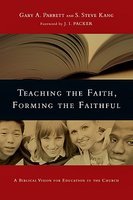 rming the Faithful: A Biblical Vision for Education in the Church by Gary Parrett and Steve Kang (Intervarsity Press). This is a massive, 450+ page book that I enjoyed on every page. My work as the director of the College Transition Initiative requires me to think and speak about developing in young people a faith that lasts. I’m also a young father, so that question is also pressing in other areas of life as well. This book was very informative, challenging the church to be more intentional in its Christian education. It connects learning to the biblical story, going into much depth as to what the church ought to teach and provides numerous, practical suggestions on how to disciple all ages.
Practice Resurrection: A Conversation on Growing Up in Christ by Eugene Peterson
 (Eerdmans). With this book, Peterson’s widely successful and deeply formative “conversations in spiritual theology” series comes to a close. The final installment discusses maturing in Christ, the church and provides insightful (as always!) commentary on the book of Ephesians. I loved it and savored it, reading a few pages a day over several months. Challenging, provocative, satisfying. Peterson continues to serve the Church he loves with passion, patience and grace.
Letters to a
 Young Calvinist: An Invitation to the Reformed Tradition by James K.A. Smith (Brazos Press). Reformed theology has been becoming more and more popular in North American Christianity. With many “emerging” churches chasing after innovations and the latest way to re-imagine/invent/think itself, the “New-Calvinists” look back to the reformation for inspiration, calling the church to deeper theological training, especially in regards to the historical doctrines and creeds. There are many positive aspects of this movement, but Smith wants to proceed with caution. He argues that the “new-Calvinism” focuses too much on TULIP and individual salvation and misses the broader perspective that Calvin himself emphasized. This collection of fictitious letters is an engaging read and a much needed voice in contemporary, Calvinist conversations.
The Fatherless Generation: Redeeming the Story by John Sowers (Zondervan). The fir
 st half of the book paints a bleak picture of fatherlessness in America. Thirty-three percent of youth—over 25 million kids—grow up without a dad. According to Sowers “the fatherless boy lives with the nagging accusation that he will never be adequate, never measure up, never really be a man.” And, “while our fatherless sons rage, our fatherless daughters decay. Driven by a crippling sense of unworthiness and a gnawing hunger for Dad, they are emotionally and sexually promiscuous.” But there is hope. The second half of the book is an urgent plea for churches to invest in intentional mentoring programs. Sowers forces us to open our eyes to the devastating crisis of fatherlessness. It is pervasive. And because it affects everyone in some way, everyone should read this book. If you come from a fatherless background this book will help you to make sense of your situation. Youth workers should read this book in order to better understand how to serve the fatherless in their congregations and communities. And, finally, fathers should read this book to be reminded of the importance and challenge of being a faithful dad.
Basic Chri
 stian: The Inside Story of John Stott by Roger Steer (Intervarsity Press). I’m a big fan of John Stott. His theology continues to undergird much of my approach to issues of faith and culture. Steer writes an engaging and inspiring biography of Dr. Stott. He takes readers on an adventure into the life of one of the most influential Christians of the 20th century. Stott has quite a legacy and it is worth knowing about in detail. We are indebted to Steer for his time in writing the story of a man everyone should know.
Monday, January 3, 2011
Almost Christian: What Teens are Telling the American Church
 One of the messages that we constantly trumpet here at CPYU is this: like it or not, we MUST listen to cultural trends. And like them or not, cultural trends give us deep insights into who we are, along with who we are becoming. Then, when viewed in light of who we’re supposed to be, cultural trends help us to answer our responsibility to respond in ways that bring honor and glory to God by promoting His Kingdom values. When it comes to our kids and who they are, listening to their culture shows us what we’ve failed to do, along with what we must do. And so it is with the message of Kenda Creasy Dean’s fabulous and challenging book, Almost Christian: What the Faith of Our Teenagers is Telling the American Church (Oxford University Press, 2010).
The cultural trend Dean reminds us of is the saddening mutation of Christian faith that is embraced and lived by our kids, a faith that’s been labeled as “moralistic, therapeutic, deism” by Christian Smith and others involved with the National Study of Youth and Religion. While Smith described this disturbing cultural trend in his book Soul Searching, Dean goes a step further to offer analysis on who’s to blame, along with who needs to step up and do something – including suggestions on what to do – to remedy the decline of faith among our kids. Not surprisingly, the blame is placed first and foremost at the feet of families who have forfeited their God-given responsibility to nurture their children in the faith of the Old and New Testament. Also to blame is a church that hasn’t equipped parents to do their job. And now we are reaping the fruit in what Dean calls a “Church of Benign Whatever-ism.”
Almost Christian takes readers on a journey into what it means to promote a “consequential faith” through a variety of faith-building strategies including passing on the faith legacy through the rediscovery of the process of “catechesis,” something that’s been lost in the age of the market-driven mega-church. Readers are prompted to consider what it means and what it will take to move kids beyond embracing a self-serving spirituality to a faith that reflects the God-centeredness and other-centeredness of the Gospel.
This is a book highly recommended for youth workers and parents, but it’s also a necessary read for pastors, church boards, and whoever else is pondering what it means to be the church in today’s rapidly changing culture.
--Walt Mueller
Tuesday, December 21, 2010
Love Is an Orientation
 The first words of Andrew Marin’s book, Love Is an Orientation: Elevating the Conversation with the Gay Community (InterVarsity Press, 2010), reads as a statement that reflects my own life: “I am a straight, white, conservative, Bible-believing, evangelical male. I was raised in a Christian home in a conservative suburb of Chicago and grew up in a large evangelical church. And I wanted absolutely nothing to do with the gay, lesbian bisexual and transgender (GLBT) community.” However, over the last 10 years he has immersed himself in this community choosing to live in the gay district of Chicago called Boystown. One of the most polarizing discussions that can happen in our church today surrounds the topic of homosexuality. As someone that works often to illuminate and prompt dialogue on sexuality, this can be one of the most sobering and difficult conversations I have. To be honest, I would rather not discuss this topic because I know what lies beneath and it is neither easy nor quick to understand.
Marin’s story begins when three of his best friends “come out” over a three-month period. This title wave of revelation led him to deeply consider what he believed and how he was going to cope with this new reality, all three of his closest friends were gay! His decision, however, was one that some find strange. In order to completely answer the Holy Spirit’s call in his life, he decided to fully immerse himself in the GLBT community. Marin says that he wanted to be, “the most involved, gayest straight dude on the face of the earth.”
His immersion in this culture is what led him to write Love Is an Orientation. It is a challenging, yet dynamic work of literature on the issues surrounding the intersection of the church and the GLBT community. He points out that we need to begin moving past our default responses toward the GLBT community. He is not asking Christians to change their beliefs, nor is he asking them to change their foundational understanding of Scripture. His heart is to create a new paradigm that elevates our discussion on this issue.
Marin writes, “We have no problem wrestling with apologetics for people of different ethnicities and cultures that are totally removed from ours. Christians diligently study other belief systems and incarnationally move into neighborhoods of people with different beliefs, join their groups, attend their events and partake in their daily life, reveling in the unique opportunity to engage in what we don’t know. But Christians do none of those things for the GLBT community.”
Love Is an Orientation will challenge you to believe that their lives are as real as ours, and our faith in Jesus Christ requires us to meticulously seek honest transparency not only within the GLBT community but in ourselves as well.
Friday, December 17, 2010
Hipster Christianity?
 What does it mean for the church to be hip? Is cool Christianity something we should even strive for? These are a few of the questions that frame Brett McCracken’s Hipster Christianity: When Church and Cool Collide (Baker Books, 2010). The book has received a lot of attention, garnering both praise and criticism. While some of the generalizations and presuppositions McCracken makes through the early portions of the book may miss the mark, the book lands on solid ground as McCracken comes to his conclusions in the latter chapters.
The book takes us through a historical look at the concept of cool and what it has looked like in practice over the years. Though nowhere near exhaustive, it provides a broad view that helps paint the picture of hipsterdom and some of its main tenets of freedom, individualism, exclusivity, and rebellion. Hipster Christianity then describes what hipsters look like in today’s society, generalizing them into twelve basic categories based on the author’s experiences. (Insert ironic criticism here.) McCracken then takes us on a tour of what he considers the rise of hipster Christianity dating back to the 1960’s. Those who grew up in evangelical homes during the 80’s and 90’s will at least relate to, if not appreciate McCracken’s references during this time period. The middle portion of the book focuses on what so-called “hipster Christianity” looks like today in practice, starting with a brief but helpful profile of several different well-known churches.
As stated before, the book holds the most weight in the concluding chapters as McCracken takes a look at whether the concept of “cool” can be reconciled with Christianity. In short, McCracken states that it cannot. Though he does allow that following Christ is a “cool” venture all to itself, he argues it’s not the same type of self-obsessed notion of cool that we have come to highly regard as a culture. If we’re not careful, and if we don’t hold tight to Scripture, the church can quickly lose its identity as found in being the body of Christ, and instead be focused on how attractive we look to the outside world. He suggests that churches who are trying to be cool simply for the sake of marketing to young believers or seekers, or to satisfy the fleeting desires of the “marketplace” are no different than corporations advertising their latest products. To be a radical for Christ means to deny oneself, and be fixated on the eternal aspect of God’s kingdom, rather than the vain, in the now, fleeting pursuits of “hip.” For many individuals and churches, this will be a tough pill to swallow.
Youth pastors and pastors alike would do well to read the final five chapters of this book. It will help them take a closer look at the decisions their churches make and hopefully encourage them to base those decisions on the unchanging Word of God rather than their personal desire to be cool or to appeal to the outside world.
--Chris Wagner
Monday, December 13, 2010
Looking for the King this Christmas?
Just in time for the release of the latest Narnia movie, The Voyage of the Dawn Treader, and for the gift-giving Christmas season, our good friend Byron Borger, proprietor of our favorite bookstore, Hearts & Minds, has assembled an excellent list of C.S. Lewis resources. Byron writes, “This year has marked some very important new C.S. Lewis resources, books and audio and--yes--some educational DVDs that are sorely needed, to enhance our appreciation of the great Oxford don.” Please check out Byron’s great list and, perhaps, think of that special someone who would greatly benefit from reading a book about or by C.S. Lewis.
Byron briefly mentions a new novel by David Downing that we are excited about. Check out the trailer above for the “Inklings” novel, Looking for the King. Is that not the best book trailer you’ve ever seen? Dr. Downing is a friend, teaches at the college up the street from CPYU’s office and a few years ago helped us see what C.S. Lewis might have to say to Christian students making the transition from high school to college (C.S. Lewis for College Students). His new novel also contains some “imagined” conversations with Lewis. While the trailer highlights the adventurous aspects of the story, the best parts of the book, in my opinion, are the conversations between the main characters and Lewis and his friends. Did you ever wonder what it would be like to have a cup of coffee with Lewis? Do you dream of the opportunity to meet J.R.R. Tolkien at a pub? This book is for you! And, if you’re just looking for a thoughtful, page-turning mystery, this book is for you too! It would be a wonderful gift for both Lewis fans and for friends learning about Lewis for the first time.
Tis the season to give books as gifts. David Downing (and Lewis) always seem to make my Christmas shopping a little bit easier!
--Derek Melleby
Subscribe to:
Posts (Atom)

 Posts
Posts